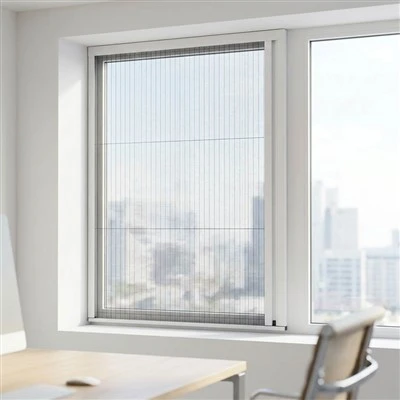
A reliable mosquito screen factory should control quality at every production stage, from incoming mesh and aluminum profiles to final dimensional inspection and packaging. For B2B buyers, screen product QC should be verified through measurable inspection points, documented tolerances, material checks and batch traceability rather than a final visual inspection alone.
1. Why Screen Product QC Matters for B2B Procurement
Mosquito screens are assembled products. Their performance depends on several components working within defined dimensional limits:
Mesh must maintain consistent opening size and tension.
Aluminum extrusion profiles must meet dimensional requirements.
Rollers, handles, magnets, springs and other hardware must operate consistently.
Frame dimensions must correspond with the customer's window or door opening.
Assembly tolerances must prevent binding, excessive gaps or mesh deformation.
Packaging must protect finished products during international transportation.
A defect in one component can create a field failure even when the remaining components meet specification.
For distributors and project contractors, the practical objective is therefore not simply "good quality." The objective is repeatable quality across production batches.
2. Incoming Material Inspection Before Production
Quality control starts before cutting, weaving, extrusion processing or assembly.
2.1 Mesh Inspection
Common insect-screen materials include fiberglass, polyester and aluminum mesh. The factory should verify the material against the approved specification before it enters production.
| QC Item | Typical Inspection Method | Buyer Concern |
|---|---|---|
| Mesh material | Material/specification verification | Wrong material substitution |
| Mesh count | Optical or manual counting | Inconsistent insect barrier |
| Mesh opening | Microscopic measurement | Passage of smaller insects |
| Width | Tape/ruler measurement | Production yield |
| Surface condition | Visual inspection | Broken or distorted yarns |
| Color | Sample comparison | Batch color variation |
| Tear/damage | Visual and physical inspection | Premature failure |
| Roll length | Measurement | Quantity discrepancy |
For high-volume orders, the supplier should maintain a retained reference sample or approved master sample. Production rolls can then be compared against the approved specification.
2.2 Aluminum Extrusion Profile Inspection
For aluminum-frame screens, profile quality directly affects assembly accuracy.
Key checks include:
Profile width and height
Wall thickness
Straightness
Surface finish
Color consistency
Cutting deformation
Profile compatibility with the specified corner connectors or hardware
An extrusion that is slightly outside specification can produce a frame that is difficult to square, particularly on larger doors.
2.3 Hardware Inspection
Hardware should be checked according to the product design rather than treated as generic accessories.
Typical items include:
Rollers
Handles
Magnetic strips
Springs
Sliding guides
Corner pieces
Plastic clips
End caps
Fixing brackets
For magnetic screens, for example, magnet quantity, polarity, positioning and holding force can affect whether the center seam closes correctly.
3. Manufacturing Process Control
A factory inspection system should identify defects while production is still running.
3.1 Cutting Accuracy
Frame components are normally cut according to a production cutting list.
A basic dimensional inspection should record:
| Parameter | QC Focus |
|---|---|
| Cut length | Match approved cutting list |
| Cut angle | Correct assembly geometry |
| Quantity | Match production order |
| Burrs | Prevent assembly interference |
| Surface damage | Protect visible finish |
| Hole position | Match hardware location |
For rectangular screens, opposite frame members should be checked against each other. Significant dimensional differences can create a parallelogram-shaped frame instead of a true rectangle.
3.2 Frame Squareness
Frame squareness is particularly important for sliding, fixed and hinged screens.
A practical production check is to measure both diagonals:
Diagonal A ≈ Diagonal B
The allowable difference should be defined in the product specification rather than left to individual operator judgment.
For project orders involving hundreds or thousands of units, a documented tolerance is more useful than subjective statements such as "the frame looks straight."
3.3 Mesh Installation and Tension
Mesh installation requires controlled tension.
Insufficient tension can result in:
Wrinkles
Sagging
Poor appearance
Contact with moving components
Excessive tension can result in:
Frame deformation
Mesh distortion
Increased stress around fixing points
For pleated screens, the production process has an additional requirement: the pleat geometry must remain consistent across the finished panel.


6
4. Dimensional QC for Finished Screen Products
Finished-product inspection should verify the complete assembly, not only individual components.
4.1 Dimensional Inspection
Typical measurements include:
Overall width
Overall height
Frame depth
Mesh panel dimensions
Track length
Hardware position
Handle position
Magnet position
Mounting-hole location
For custom OEM orders, the inspection sheet should use the buyer's approved dimensional drawing or technical data sheet.
4.2 Functional Testing
A screen can meet dimensional requirements and still fail during operation.
Functional testing should therefore include:
| Product Type | Functional QC |
|---|---|
| Sliding screen | Opening/closing cycle, roller movement |
| Retractable screen | Extension and retraction |
| Pleated screen | Folding and extension |
| Magnetic screen door | Center closure and magnetic engagement |
| Fixed screen | Frame rigidity and mesh retention |
| Hinged screen | Opening angle, closing and latch operation |
| Roller screen | Spring return and mesh alignment |
For moving products, cycle testing is especially useful because it exposes problems that a static visual inspection cannot identify.
5. Quality Control for Different Screen Materials
Material selection affects the inspection criteria.
Fiberglass vs Polyester vs Aluminum Mesh
| Property | Fiberglass Mesh | Polyester Mesh | Aluminum Mesh |
|---|---|---|---|
| Typical application | Residential/general insect screens | Magnetic and flexible screens | Heavy-duty applications |
| Flexibility | Medium | High | Low |
| Weight | Low | Low | Higher |
| Corrosion resistance | High | High | Depends on alloy/coating |
| Dimensional stability | Good | Good | High |
| Folding suitability | Limited | Good | Poor |
| Impact resistance | Good | Moderate to good | High |
| Main QC concern | Coating and mesh consistency | Yarn integrity and deformation | Surface finish and deformation |
The correct QC system depends on the final application. A polyester magnetic screen and an aluminum sliding screen should not be inspected against identical criteria.
6. Quality Control for Aluminum Surface Finishing
Aluminum profiles are frequently exposed to handling, cutting and assembly operations that can damage the finish.
The inspection process should check:
Surface Defects
Inspect for:
Scratches
Dents
Color variation
Coating defects
Oxidation
Uneven gloss
Cutting marks
For architectural projects, the approved color sample should be retained as the reference standard.
If the project specifies black, white, grey, brown or bronze profiles, the factory should maintain a controlled color reference instead of relying only on operator memory.
7. Hardware and Assembly QC
Hardware failures are often small but can create disproportionate installation problems.
For example, incorrect roller alignment can increase operating resistance in a sliding screen. Incorrect magnet positioning can leave an opening along the center seam of a magnetic door.
Assembly Inspection Checklist
A finished screen should be checked for:
Correct component quantity
Correct hardware model
Correct hardware orientation
Secure fasteners
Correct mesh tension
Correct frame dimensions
Correct diagonal measurements
Correct handle position
Smooth operation
Correct labeling
For large B2B orders, these checks should be recorded on a production inspection sheet.
8. Final Inspection and Sampling
Final QC normally combines 100% critical checks with sampling inspection.
The appropriate inspection method depends on the product and order.
| Inspection Type | Suitable Items |
|---|---|
| 100% inspection | Product model, visible damage, basic dimensions, accessories |
| Sampling inspection | Detailed dimensional measurements |
| Functional sampling | Opening/closing and operating resistance |
| Material inspection | Incoming mesh, profiles and hardware |
| Packaging inspection | Carton strength, labels and protection |
For a large shipment, the buyer should agree with the supplier on the sampling standard before production starts.
A purchase order should define:
Inspection items
Sampling quantity
Acceptable tolerance
Defect classification
Packaging requirements
Labeling requirements
Corrective-action procedure
9. Traceability: Linking Finished Products to Production Batches
Traceability becomes more important as order volume increases.
A practical production record can include:
| Record | Information |
|---|---|
| Purchase order | Buyer and order reference |
| Product code | Model identification |
| Production date | Manufacturing batch |
| Material batch | Mesh/profile/hardware source |
| Operator/line | Production identification |
| QC record | Inspection results |
| Packing record | Carton and quantity |
| Shipment record | Container or shipment reference |
This allows a factory to identify the affected production batch if a quality issue is reported after delivery.
For distributors, this reduces the time required to investigate customer complaints.
10. Cost Factors Behind Factory QC
Quality control has a measurable cost.
The cost normally comes from:
Incoming material inspection
Skilled QC personnel
Measuring equipment
Production inspection
Functional testing
Rework
Packaging inspection
Record keeping
Sample retention
However, the more important procurement metric is often cost of non-quality.
A defective screen can generate:
Replacement product cost
Additional freight
Installation labor
Customer claims
Project delays
Distributor handling costs
For this reason, the lowest factory quotation is not necessarily the lowest total procurement cost.
Example: QC Cost vs Failure Cost
| Cost Item | Factory QC | Field Failure |
|---|---|---|
| Inspection labor | Planned | Not applicable |
| Rework | Controlled before shipment | Replacement required |
| Freight | Normal shipment | Additional freight |
| Installation | Normal | Potential second visit |
| Customer service | Routine | Complaint handling |
| Project impact | Low | Potential delay |
The exact financial impact varies by product and project, but the procurement principle is consistent: preventing defects before shipment is normally cheaper than correcting them after installation.
11. What B2B Buyers Should Ask a Mosquito Screen Factory
Before placing a large order, buyers should request evidence rather than general quality claims.
11.1 Supplier Evaluation Checklist
Ask the supplier:
What mesh specifications are available?
How is mesh count verified?
How are aluminum profiles inspected?
What dimensional tolerances are used?
How is frame squareness checked?
How are moving components function-tested?
Is there a documented final inspection?
Are production batches traceable?
How are customer-approved samples controlled?
What happens when a batch fails inspection?
Can the supplier provide inspection records?
Can packaging be customized for export distribution?
A factory that cannot explain its inspection process clearly may still produce acceptable samples, but consistent large-batch performance is harder to verify.
12. Why Factory Direct Supply Matters for QC
Working directly with a manufacturer reduces the number of quality-control handoff points between production and procurement.
For distributors and project buyers, a ►[Factory Direct Mosquito Screen Supplier] can provide direct communication between the purchasing team and production team.
This is particularly useful when an order involves:
Multiple screen models
Different mesh specifications
Custom dimensions
Multiple profile colors
OEM packaging
Private labeling
Project-specific inspection requirements
For a manufacturer with its own aluminum profile processing and screen assembly capabilities, production changes can also be coordinated without relying entirely on a third-party trading chain.
B2B Procurement CTA
Request a pre-production sample and QC checklist before confirming your bulk order. A sample approval process gives both buyer and factory a fixed reference for materials, dimensions, appearance, assembly and packaging.
13. Buyer Checklist: 10 QC Points to Confirm Before Mass Production
Before approving production, confirm these ten items in writing:
Mesh specification - material, mesh count, color and opening.
Profile specification - alloy/profile model, dimensions and finish.
Hardware specification - rollers, magnets, handles and connectors.
Finished dimensions - width, height and dimensional tolerances.
Mesh tension - acceptable visual and dimensional condition.
Frame squareness - defined diagonal tolerance.
Functional test - operating method and test requirement.
Packaging - carton, protection, labels and quantity.
Inspection standard - sampling method and defect classification.
Traceability - batch number and QC documentation.
These points should be included in the technical specification or purchase order wherever possible.
14. How to Compare Mosquito Screen Factories in China
Price should be only one line in the supplier comparison.
A practical supplier scorecard can use the following structure:
| Evaluation Category | Suggested Weight |
|---|---|
| Product quality consistency | 25% |
| Manufacturing capability | 20% |
| QC system | 20% |
| Product customization | 10% |
| Packaging and export capability | 10% |
| Lead-time performance | 10% |
| Price | 5% |
The exact weighting depends on the project. For a high-volume residential development, quality consistency and delivery reliability may have greater financial impact than a small difference in unit price.
15. Final Standard for Screen Product QC
A professional mosquito screen QC process should answer four questions:
What specification was ordered?
What material was used?
What was inspected during production?
What evidence confirms the finished product meets the specification?
For B2B procurement, these questions matter more than a generic statement that a factory has "strict quality control."
A strong QC system combines incoming material inspection, process control, dimensional measurement, functional testing, final inspection and batch traceability. The result should be a repeatable manufacturing process that produces the same specification across successive production runs.
For distributors, contractors and project procurement teams, this is the practical definition of reliable screen product QC.
FAQ
What should buyers check when evaluating screen product QC?
Buyers should verify material inspection, dimensional tolerances, frame squareness, mesh installation, hardware testing, functional testing, final inspection and production traceability.
Can mosquito screen factories provide QC samples before bulk production?
Yes. Buyers can request a pre-production sample or approved reference sample covering mesh, profile, dimensions, hardware, assembly and packaging before mass production.
How can buyers reduce quality problems in large mosquito screen orders?
Define specifications and tolerances before production, approve a reference sample, agree on inspection criteria, require batch records and conduct pre-shipment inspection before container loading.
Need a Factory QC Sample Before Your Bulk Order?
Send your product specifications, target dimensions and estimated order quantity to Xiamen Weiziran for a production sample and B2B quotation.