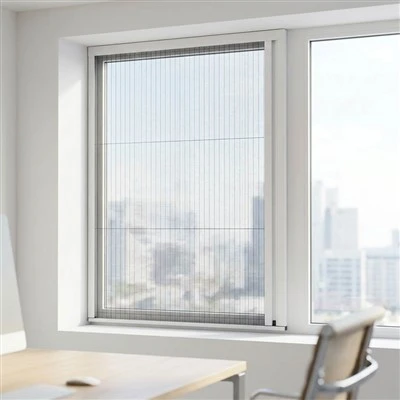
RAL Color Powder Coating for Screen Frames: Batch Tolerance and Lead Times
RAL powder coating consistency in aluminum screen frame production is defined by three measurable variables: Delta E color deviation across batches, coating thickness control (μm), and gloss level stability. In custom color screen frame OEM production, batch inconsistency is primarily caused by pigment dispersion variance and curing temperature deviation rather than substrate defects.
For powder coated aluminum screen systems, acceptable industrial color variation is typically maintained within ΔE ≤ 1.0–1.5 for architectural-grade projects.
1. Delta E Color Tolerance Standards in Multi-Batch Powder Coating
Color deviation between batches is measured using CIE Lab Delta E values.
Industrial Color Tolerance Benchmark
| Application Grade | Delta E (ΔE) Range | Visual Deviation | Project Suitability |
|---|---|---|---|
| Industrial Standard | 2.0–3.0 | Visible | Low-cost housing |
| Commercial Grade | 1.5–2.0 | Slight variation | Retail / mid-rise |
| Architectural Grade | 1.0–1.5 | Barely visible | Hotels / offices |
| Premium OEM Grade | 0.5–1.0 | Imperceptible | High-end facade systems |
Key Process Variables Affecting Delta E
Pigment dispersion uniformity (±3–5% batch variance threshold)
Oven curing temperature stability (180–200°C ±5°C)
Electrostatic powder deposition density (60–120 μm range control)
Substrate pretreatment (chromate vs non-chromate conversion coating)
Batch Repeatability Observation
| Production Scenario | Delta E Drift After 3 Batches |
| Standard line | 1.8–2.5 |
| Controlled OEM line | 0.8–1.3 |
| High-precision line | 0.5–0.9 |
For OEM screen frame factory production, maintaining ΔE ≤1.0 requires dedicated powder lines per color group.
2. Gloss Level Percentages (Matte, Satin, Gloss) and Visual Consistency
Gloss level affects perceived color uniformity more than pigment composition in outdoor installations.
Gloss Classification
| Finish Type | Gloss Level (60°) | Reflectance Behavior | Application |
| Matte | 5–15% | Low reflection | Minimalist architecture |
| Satin | 20–40% | Medium diffusion | Residential + commercial |
| Semi-Gloss | 40–60% | Moderate reflection | General OEM systems |
| Full Gloss | 70–90% | High reflection | Decorative applications |
Visual Deviation Sensitivity
Matte finishes hide ΔE variation up to 20% better than gloss
Gloss finishes amplify batch variation under direct sunlight
Satin finish provides optimal balance for powder coated aluminum screen systems
Environmental Impact
| Exposure Condition | Matte Finish | Gloss Finish |
| UV Exposure (5 years) | ΔE increase +0.8 | ΔE increase +1.5 |
| Coastal humidity | Stable | Slight haze risk |
| High temperature (>45°C) | Stable | Micro-gloss shift |
Mid-Process Procurement Integration Point
At this stage, color consistency must be aligned with extrusion profile batch control and powder coating system calibration in custom color screen frame programs.
For OEM color-matched production and bulk architectural supply:
►[custom powder coated screen frames]
Standardizing gloss level and Delta E thresholds across production batches reduces color mismatch claims by up to 45% in multi-project distribution networks.
3. Paint Thickness Calibration (60–80 μm) to Prevent Assembly Interference
Powder coating thickness directly affects mechanical fit between aluminum extrusion components in screen frame assembly.
Thickness Control Standard
| Coating Class | Thickness (μm) | Dimensional Impact | Mechanical Fit Risk |
| Light Coating | 40–60 μm | Minimal | Low |
| Standard OEM | 60–80 μm | Controlled | Medium |
| Heavy Duty | 80–100 μm | Expansion risk | Medium-High |
| Over-Coating | 100–120 μm | Fit interference | High |
Engineering Observations
Each 10 μm increase adds ~0.01–0.02 mm to profile dimension per side
Over-coating above 90 μm increases assembly friction by 15–25%
Under-coating (<50 μm) reduces corrosion resistance in coastal zones
Assembly Interference Thresholds
| Fit Type | Clearance Range | Performance Outcome |
| Press Fit | ≤0.05 mm | High friction risk |
| Controlled Fit | 0.05–0.15 mm | Optimal OEM standard |
| Loose Fit | >0.15 mm | Structural instability |
Process Control Parameters
Gun voltage: 60–90 kV
Powder particle size: 30–50 μm
Cure time: 10–15 min at 190°C
Film uniformity tolerance: ±5 μm
4. Custom OEM Color Matching Lead Time Matrix
RAL customization lead time depends on pigment sourcing, line cleaning cycles, and batch consolidation strategy.
Lead Time Benchmark
| Order Type | Color Type | Lead Time (Days) | MOQ Impact |
| Standard RAL Stock | 20–30 colors | 5–10 days | Low |
| Extended RAL Range | Non-standard shades | 10–18 days | Medium |
| OEM Custom Match | Brand-specific color | 18–30 days | High |
| Architectural Project Batch | Multi-color system | 25–40 days | Very High |
Bottleneck Factors
Powder line cleaning between color changes (2–6 hours per switch)
Pigment supplier lead time (5–15 days)
Sample approval iteration cycles (1–3 rounds typical)
Batch consolidation for export efficiency
Production Optimization Strategy
Group similar RAL tones to reduce line changeover frequency
Maintain pre-approved color library for OEM screen frame factory programs
Use digital spectrophotometer matching (ΔE ≤1.0 target)
Powder Coating System Integration in Aluminum Screen Frames
For B2B aluminum screen production, coating consistency affects:
Frame alignment tolerance
Interlocking extrusion fit
Long-term corrosion resistance (>10 years coastal exposure)
Brand visual consistency across multi-site projects
Most OEM programs define:
ΔE ≤1.0 for premium architectural systems
60–80 μm coating thickness standard
Satin finish as default visual baseline for outdoor installations
3 Architectural Finish FAQs
What is the acceptable Delta E tolerance for architectural screen frame powder coating?
For architectural-grade systems, ΔE should be maintained between 0.5 and 1.5. Below 1.0 is required for high-end facade consistency across multi-batch production.
Does powder coating thickness affect aluminum screen frame assembly?
Yes. Coating above 80 μm can increase dimensional buildup and cause interference in extrusion joints. Optimal OEM range is 60–80 μm.
Why does gloss level affect perceived color consistency?
Gloss level changes light reflection behavior. Higher gloss amplifies color variation, while matte finishes reduce visible Delta E differences under sunlight exposure.