Mosquito screens can reduce the entry of some airborne particles, but standard insect mesh is not designed to function as a pollen or fine-dust filter. For projects requiring a pollen resistant window screen, the key variables are mesh aperture, fiber diameter, open-area ratio, airflow resistance and the target particle size.
1. Why Standard Mosquito Screens Do Not Fully Block Pollen
The primary function of a mosquito screen is insect exclusion. Its openings are engineered to prevent mosquitoes, flies and other insects from passing through while maintaining ventilation.
Pollen and dust behave differently because their particle sizes vary widely.
Typical pollen grains are often much larger than fine particulate matter, but they are not uniform in shape or size. Dust can range from relatively large visible particles to very fine particles that pass through conventional insect mesh.
This creates an important distinction for procurement:
A tighter screen can reduce some pollen and larger dust particles, but a conventional mosquito screen should not be specified as an air-purification filter.
For residential window and door projects, the correct specification depends on whether the priority is insect protection, pollen reduction, airflow, visibility or a combination of these requirements.
Particle size versus screen opening
| Material / Particle | Approximate Size Range | Can Standard Insect Mesh Block It? |
|---|---|---|
| Mosquito | ~2–6 mm | Yes |
| Large pollen grains | ~30–100+ μm | Generally not reliably |
| Smaller pollen grains | ~10–30 μm | No, with conventional insect mesh |
| Coarse dust | >50 μm | Some particles may be retained |
| Fine dust | <10 μm | No |
| PM2.5 | ≤2.5 μm | No |
Particle dimensions vary considerably by species and measurement method, so these values should be treated as engineering reference ranges rather than universal limits.
2. Mesh Aperture Is the First Specification to Check
For a pollen resistant window screen, mesh aperture is more important than simply stating the material as fiberglass or polyester.
A screen with an 18 × 16 mesh count, for example, has a very different filtration performance from a finer mesh with a substantially smaller aperture.
The basic relationship is:
Smaller aperture = greater particle interception potential + higher airflow resistance.
This is a physical trade-off rather than a marketing specification.
Typical insect-screen mesh configurations
| Mesh Type | Typical Mesh Count | Relative Aperture | Airflow | Pollen Reduction Potential |
|---|---|---|---|---|
| Standard fiberglass | 18 × 16 | Medium | High | Low |
| Fine fiberglass | 20 × 20 | Smaller | Medium | Moderate for larger particles |
| Fine polyester | 20 × 20 or higher | Smaller | Medium | Moderate |
| Micro-screen / filter mesh | Project-specific | Very small | Lower | Higher, depending on particle size |
| HEPA-type filter media | Not comparable | Micron-scale | High resistance | Designed for fine particles |
The last category should not be confused with conventional window screening. HEPA media and insect mesh serve fundamentally different purposes.
3. Fiberglass Mesh vs. Polyester Mesh for Particle Reduction
Material selection affects durability, dimensional stability, flexibility and screen construction. It does not automatically determine pollen filtration performance.
The opening size and mesh geometry remain the primary variables.
Fiberglass mesh
Fiberglass mesh is widely used for fixed and retractable insect screens because it provides good dimensional stability and resistance to heat and outdoor exposure.
For high-volume residential projects, fiberglass can be suitable when the primary requirement remains insect protection with moderate particle reduction.
Polyester mesh
Pleated polyester and other polyester screen materials offer greater flexibility, which makes them suitable for folding and retractable systems.
Polyester is commonly used where the screen must repeatedly fold, extend or retract without relying on a rigid mesh structure.
| Parameter | Fiberglass Mesh | Polyester Mesh |
|---|---|---|
| Dimensional stability | High | Medium–High |
| Flexibility | Medium | High |
| Typical application | Fixed/retractable insect screens | Pleated/retractable screens |
| Folding performance | Limited | Good |
| Abrasion resistance | Good | Good, grade-dependent |
| Fine-mesh availability | Yes | Yes |
| Pollen filtration | Depends mainly on aperture | Depends mainly on aperture |
For procurement teams, specifying only "fiberglass" or "polyester" is insufficient. The technical quotation should include mesh count, wire/fiber diameter, aperture and open-area ratio.
4. Smaller Mesh Openings Increase Airflow Resistance
Reducing the mesh aperture increases the number of fibers occupying a given surface area.
That can improve particle interception, but it also reduces the free area available for air movement.
This matters in residential buildings where natural ventilation is part of the window design.
A very fine mesh may provide greater resistance to pollen entry but can also produce:
Lower natural airflow
Higher pressure drop
More visible mesh
Faster accumulation of dust
More frequent cleaning requirements
Higher manufacturing and material costs
For large residential developments, the correct approach is to define the required performance before selecting the finest available mesh.
5. Can a Pleated Screen Door Reduce Pollen Entry?
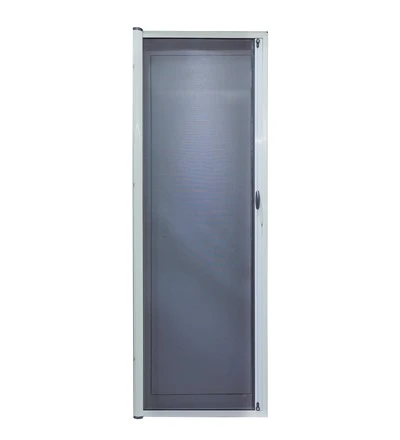
A ►[Pleated Screen Door] can reduce the passage of larger airborne particles when fitted with a relatively fine mesh, but it should not be described as a dedicated pollen filtration system unless the mesh has been tested for a defined particle-size range.
Pleated systems are particularly useful for large door openings because the mesh can fold into a compact stack when the opening is not in use.
For balconies, patio doors and large residential openings, procurement teams should evaluate:
Mesh aperture
Mesh material
Pleat depth
Frame dimensions
Track configuration
Operating cycles
Wind exposure
Cleaning access
A pleated polyester screen with a fine mesh can provide a practical compromise between insect protection, ventilation and partial particle reduction.
For B2B projects, request the mesh specification and sample before approving a production batch. A physical sample allows the buyer to check visibility, airflow, mesh rigidity and cleaning behavior at the same time.
6. Retractable Window Screens for Ventilation-Focused Projects
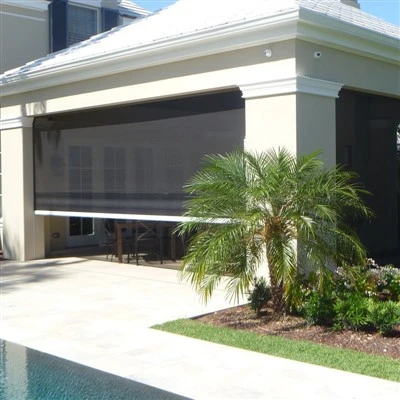
A ►[Retractable Window Screen] is appropriate where the screen needs to remain open when ventilation or unobstructed views are required.
Retractable systems can use different mesh grades depending on the application. The screen can be deployed when insects are present and retracted when it is not required.
For pollen-sensitive residential projects, however, the specification should not stop at "retractable."
A purchasing specification should state:
| Specification | Recommended Procurement Information |
|---|---|
| Mesh material | Fiberglass / polyester |
| Mesh count | Exact count, e.g. 18 × 16 or 20 × 20 |
| Aperture | Actual opening dimension |
| Fiber diameter | mm |
| Open-area ratio | % |
| Frame material | Aluminum extrusion profile |
| Surface finish | Powder coating / anodized finish |
| Screen width | Project-specific |
| Screen height | Project-specific |
| Operating method | Manual / retractable / pleated |
| Cleaning method | Vacuum / brush / removable cleaning |
| Test requirement | Project-defined particle or insect performance |
This specification prevents suppliers from substituting a different mesh while keeping the same generic product name.
7. Dust Accumulation Is a Maintenance Issue
A finer screen can intercept more airborne material, but that also means more material can accumulate on the mesh surface.
As dust and pollen build up, the effective open area decreases.
The result can be a gradual reduction in airflow even if the mesh itself has not changed.
For residential projects, cleaning requirements should therefore be included in the product specification.
Practical maintenance considerations
Clean mesh regularly during high-pollen seasons.
Remove loose dust before washing.
Use a soft brush or low-suction vacuum.
Avoid aggressive brushing that can deform fine polyester mesh.
Check the frame and track for accumulated debris.
Inspect mesh tension after cleaning.
Replace mesh showing permanent deformation or tears.
For high-rise projects, maintenance access should also be considered before selecting an externally mounted screen system.
8. How Buyers Should Specify a Pollen Resistant Window Screen
The phrase "pollen resistant window screen" can describe several different products. Without measurable parameters, supplier quotations are difficult to compare.
A better purchasing specification separates the requirements into four groups.
Mesh performance
Specify:
Mesh count
Aperture size
Fiber diameter
Material
Open-area ratio
Color
UV exposure requirements
Mechanical performance
Specify:
Tear resistance
Tensile strength
Dimensional stability
Repeated operating cycles
Edge attachment method
Frame performance
For aluminum systems, specify:
Aluminum alloy
Profile dimensions
Wall thickness
Surface treatment
Corner connection
Track dimensions
Environmental performance
Specify:
Indoor/outdoor application
UV exposure
Rain exposure
Coastal salt exposure
Expected operating temperature
Cleaning frequency
This information gives the manufacturer a measurable engineering target instead of a generic product description.
9. Cost Factors for Large Residential Orders
Fine mesh generally requires more material per square metre and may require tighter manufacturing tolerances.
The final project cost also depends on the screen construction.
| Cost Factor | Effect on Unit Cost |
|---|---|
| Standard fiberglass mesh | Lower |
| Fine fiberglass mesh | Moderate increase |
| Fine polyester mesh | Moderate increase |
| Custom mesh aperture | Depends on production volume |
| Custom aluminum extrusion | Higher tooling cost |
| Custom frame color | May increase finishing cost |
| Large screen dimensions | Higher material and packaging cost |
| Pleated mechanism | Higher component count |
| Retractable mechanism | Higher hardware cost |
| Individual packaging | Higher packing and labor cost |
| Small MOQ | Higher unit cost |
For developers and distributors, the lowest mesh price is not necessarily the lowest project cost. Replacement rates, installation labor and warranty claims can have a larger effect on total procurement cost.
10. Supplier Selection: What to Verify Before Ordering
A reliable supplier should be able to provide more than product photographs and a catalogue specification.
Before placing a production order, ask for:
1. Physical mesh sample
Check:
Aperture uniformity
Mesh count
Surface defects
Fiber consistency
Color consistency
Flexibility
2. Complete technical drawing
The drawing should identify:
Overall dimensions
Aluminum profile
Mesh position
Track dimensions
Corner construction
Hardware
Installation clearance
3. Production quality controls
Ask how the supplier controls:
Incoming mesh inspection
Aluminum profile dimensions
Powder coating quality
Cutting accuracy
Mesh assembly
Final dimensional inspection
Packaging
4. Batch traceability
For large projects, production records should allow the supplier to identify the material batch and production date if a quality issue occurs.
5. Sample approval procedure
The approved sample should become the physical reference for mass production.
This is particularly important for fine-mesh products because small differences in aperture, color or tension can be visible across hundreds of installed units.
11. Recommended Specification for B2B Residential Projects
For a residential development, a practical specification can be structured as follows:
Application: Residential window and door insect protection
Primary function: Mosquito and flying-insect exclusion
Secondary function: Reduction of larger airborne particles
Mesh: Fiberglass or polyester, project-selected
Mesh count: To be confirmed according to required aperture
Frame: Aluminum extrusion profile
Finish: Powder-coated or anodized
System: Fixed, pleated or retractable
Dimensions: Project-specific
Color: Project-specific
Packaging: Individual or bulk packaging
Quality control: Pre-production sample approval + batch inspection
The specification should avoid claiming that an insect screen provides HEPA-level filtration or PM2.5 removal unless independent test data supports that claim.
12. Why Work With a Factory-Direct Screen Manufacturer?
For distributors, contractors and developers, direct manufacturing provides greater control over the variables that affect final screen performance.
Xiamen Weiziran manufactures mosquito screens and aluminum screen-system components for export markets, allowing buyers to discuss mesh selection, frame dimensions, colors, packaging and project quantities directly with the production team.
For buyers comparing suppliers, a ►[Factory Direct Mosquito Screen Supplier] should be evaluated on measurable production capability rather than catalogue variety alone.
A useful supplier comparison should include:
| Evaluation Item | What to Request |
|---|---|
| Mesh specification | Count, aperture, material |
| Aluminum profile | Drawing and dimensions |
| MOQ | Exact quantity |
| Sample | Physical pre-production sample |
| Lead time | Sample + mass production |
| QC | Inspection procedure |
| Packaging | Carton dimensions and protection |
| Customization | Available dimensions and colors |
| Export experience | Destination markets |
| After-sales | Replacement and claim process |
Conclusion: Treat Pollen Reduction as a Mesh-Engineering Problem
Mosquito screens and pollen filters are not the same product category. A conventional insect screen can reduce the entry of some larger pollen and dust particles, but fine pollen and small particulate matter require significantly smaller filtration media.
For B2B residential projects, the correct solution starts with measurable specifications: mesh aperture, fiber diameter, open-area ratio, airflow, mechanical strength and system design.
If your project requires a pollen resistant window screen, provide the target window dimensions, application, preferred mesh material, ventilation requirements and expected order quantity. A supplier can then recommend a mesh and screen construction based on engineering parameters rather than a generic "anti-pollen" label.
Request a product sample and bulk quotation before final project approval. Compare the actual mesh aperture, visibility, airflow and frame construction before committing to the full production quantity.
FAQ
Can a standard mosquito screen block pollen?
A standard insect screen can retain some larger pollen particles, but it is not a dedicated pollen filter. Fine pollen and small airborne particles can pass through conventional insect mesh.
What mesh is best for a pollen resistant window screen?
A finer mesh with a smaller aperture generally provides greater particle interception, but it also reduces airflow. The correct specification should balance aperture size, ventilation, visibility and cleaning requirements.
Can pleated screen doors be used for pollen-sensitive homes?
Yes. A pleated screen door can use fine polyester or fiberglass mesh to reduce some larger airborne particles while providing insect protection. It should not be marketed as a fine-particle air filter without supporting test data.