1. Recess Fit vs Face Fit: The Basic Difference
The primary difference is where the aluminum screen frame is positioned relative to the window opening.
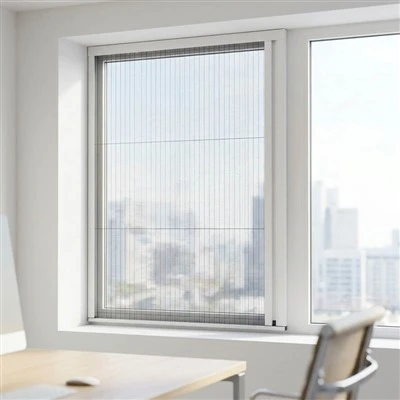
A recess-fit screen is installed within the window reveal. The frame therefore has to fit the measured opening without interfering with the sash, glazing beads, handles, drainage paths, or other hardware.
A face-fit screen is installed against the face of the opening. The screen frame covers the perimeter of the opening and is generally less dependent on the exact internal reveal depth.
| Specification | Recess Fit Screen | Face Fit Screen Frame |
|---|---|---|
| Mounting position | Inside window reveal | On face of opening/frame |
| Main dimensional reference | Internal opening | Overall face dimensions |
| Reveal depth | Must be sufficient | Less restrictive |
| Measurement sensitivity | High | Moderate |
| Visible frame position | Recessed | Projects toward room/exterior side |
| Typical fixing | Clips, brackets, channels or pressure fit | Screws, brackets, clips or magnetic fixing |
| Installation tolerance | Relatively tight | Generally more forgiving |
| Suitable for irregular reveals | Limited | Often easier to accommodate |
| Main procurement risk | Incorrect opening measurement | Incorrect overall coverage dimension |
For large residential projects, distributors should define the fit type before requesting a quotation. Mixing recess-fit and face-fit dimensions in the same order can result in incorrect frame sizes even when the nominal window sizes are identical.
2. Recess-Fit Screens: Clearance Requirements
2.1 Measure the finished opening, not the nominal window size
For a recess-fit screen, suppliers normally need the actual finished opening dimensions.
Measure:
Width at the top, middle, and bottom
Height at the left, center, and right
Reveal depth at several points
Squareness of the opening
Obstructions around the perimeter
Handle and sash clearance
Drainage or ventilation openings
A practical measurement record should therefore look like this:
| Measurement | Required Data |
|---|---|
| Opening width W1 | Top |
| Opening width W2 | Center |
| Opening width W3 | Bottom |
| Opening height H1 | Left |
| Opening height H2 | Center |
| Opening height H3 | Right |
| Minimum reveal depth | mm |
| Frame-to-sash clearance | mm |
| Obstruction clearance | mm |
| Required screen frame size | mm |
The smallest measured width and height should be considered when the opening is not perfectly uniform.
2.2 Clearance is part of the product specification
A recess-fit frame cannot simply be manufactured to the same dimensions as the measured opening. Some clearance is normally required for installation and removal.
The required allowance depends on:
Aluminum profile geometry
Fixing system
Screen frame dimensions
Manufacturing tolerance
Window opening tolerance
Installation method
For this reason, procurement documents should state whether dimensions represent finished screen size, opening size, or cut size.
3. Face-Fit Screen Frames: Dimension and Coverage
A face-fit screen frame is positioned over the face of the opening rather than inside the reveal.
The key measurement is therefore the required overall screen coverage.
3.1 Typical face-fit dimensional logic
If the clear opening is 1,200 mm wide and the frame requires 25 mm coverage on each side, the nominal overall screen dimension becomes:
| Parameter | Example |
|---|---|
| Clear opening width | 1,200 mm |
| Left frame coverage | 25 mm |
| Right frame coverage | 25 mm |
| Overall screen width | 1,250 mm |
The same principle applies vertically.
However, the actual coverage requirement must be determined from the fixing method and the geometry of the existing window. A 25 mm example should not be treated as a universal installation requirement.
3.2 Face-fit systems can reduce reveal dependency
Because the frame is mounted on the face of the opening, variations in reveal depth may have less impact than they would with a recess-fit design.
This can be useful for:
Older residential buildings
Renovation projects
Mixed window systems
Openings with shallow reveals
Projects where internal reveal dimensions vary
For standardized new-build projects, however, both systems can be specified if the window geometry and installation method are controlled.
4. Frame Dimensions and Aluminum Profile Selection
The aluminum extrusion profile determines much more than the visible frame width.
Profile selection affects:
Structural stiffness
Mesh retention
Corner connection
Screw engagement
Overall frame weight
Visible sightline
Installation clearance
Resistance to frame deformation
A typical procurement specification should identify the profile section rather than simply stating "aluminum frame."
| Profile Parameter | Procurement Specification |
|---|---|
| Alloy | Specify alloy and temper |
| Profile type | Fixed screen / removable screen / custom |
| Wall thickness | Specify drawing value |
| Surface finish | Powder coating / anodizing |
| Finish color | RAL or approved color reference |
| Profile width | mm |
| Profile depth | mm |
| Mesh retention | Spline / channel / other |
| Corner connection | Plastic / aluminum / mechanical |
| Maximum frame size | Supplier-tested value |
For projects using a dedicated ►[Aluminum Screen Frame], the profile drawing should be approved before mass production.
The supplier should provide a dimensional drawing showing:
External frame dimensions
Internal mesh opening
Profile cross-section
Corner geometry
Fixing position
Mesh retention channel
Required installation clearance
5. Installation Tolerance: Where Bulk Orders Often Fail
5.1 Manufacturing tolerance and installation tolerance are different
These two terms should not be combined.
Manufacturing tolerance describes how much the finished screen may vary from the specified production dimension.
Installation tolerance describes the dimensional variation that the building opening can accommodate.
For example:
| Parameter | Example Specification |
|---|---|
| Ordered frame width | 1,200 mm |
| Manufacturing tolerance | ±1.0 mm |
| Actual acceptable production range | 1,199–1,201 mm |
| Building opening variation | Project-specific |
| Required installation clearance | Project-specific |
The actual tolerances must be agreed with the manufacturer based on profile geometry and fixing design.
5.2 Why tolerance stacks matter
Consider a recess-fit screen where:
Window opening varies by ±2 mm
Aluminum frame manufacturing varies by ±1 mm
Installation position varies by ±1 mm
The combined dimensional risk is not necessarily solved by simply requesting a tighter extrusion tolerance.
The buyer should instead define a complete dimensional chain:
Building opening → required clearance → screen frame dimension → profile tolerance → mesh installation tolerance
This approach is more reliable than specifying an arbitrary ±0.5 mm value without considering the complete installation system.
6. Recess Fit vs Face Fit: Procurement Comparison
| Procurement Factor | Recess Fit | Face Fit |
|---|---|---|
| Measurement accuracy required | High | Medium |
| Reveal depth verification | Required | Less important |
| Irregular openings | More difficult | Generally easier |
| Visible projection | Lower | Higher |
| Removal access | Depends on design | Usually accessible |
| Retrofit applications | Project-dependent | Often suitable |
| New-build applications | Suitable | Suitable |
| Risk from incorrect width | High | High |
| Risk from incorrect depth | High | Lower |
| Best quotation input | Opening dimensions + reveal | Overall coverage dimensions |
Neither system should be selected from the nominal window width alone.
7. What Buyers Should Include in a Quotation Request
A quotation request for screen frames should contain enough technical information for the supplier to calculate the finished product correctly.
Minimum information for each size
| Item | Example |
|---|---|
| Fit type | Recess fit |
| Opening width | 1,200 mm |
| Opening height | 1,500 mm |
| Reveal depth | 45 mm |
| Screen frame profile | Drawing/specification |
| Mesh type | Fiberglass |
| Mesh density | 18 × 16 |
| Mesh color | Charcoal |
| Frame finish | Powder coated |
| Frame color | RAL reference |
| Fixing system | Clips |
| Quantity | 500 pcs |
| Packaging | Individual / bulk |
| Installation location | Interior / exterior |
For face-fit screens, replace the opening dimensions with the required finished screen dimensions and perimeter coverage.
B2B CTA: Request a Dimensional Review
For a project order, send the window schedule, opening dimensions, profile drawing, mesh specification, required finish and quantity before finalizing the quotation. A supplier can then review the dimensional chain and identify missing information before production.
8. Custom Window Screen Dimensions for Project Orders
For mixed-size projects, buyers should avoid sending only a list such as:
1,200 × 1,500 mm - 200 pcs
The supplier also needs to know whether these are:
Clear opening dimensions
Finished screen dimensions
External frame dimensions
Internal frame dimensions
Recess dimensions
For a project with 20–50 different window sizes, a standardized window schedule reduces interpretation errors.
A recommended schedule is:
| SKU | Fit | Opening W | Opening H | Reveal | Finished W | Finished H | Mesh | Qty |
|---|---|---|---|---|---|---|---|---|
| A01 | Recess | 1,200 | 1,500 | 45 | Supplier-defined | Supplier-defined | Fiberglass | 100 |
| A02 | Recess | 1,000 | 1,200 | 42 | Supplier-defined | Supplier-defined | Fiberglass | 80 |
| B01 | Face | 1,200 | 1,500 | - | 1,250 | 1,550 | Fiberglass | 120 |
The final dimensions should be confirmed on the approved production drawing rather than inferred from the table.
9. Supplier Evaluation: Five Technical Questions
Before placing a bulk order, procurement teams should ask the supplier:
1. Can you provide the aluminum profile drawing?
The drawing should show the complete cross-section, critical dimensions, mesh channel and fixing interface.
2. What tolerance is controlled during frame assembly?
Do not evaluate extrusion tolerance alone. Finished-frame dimensional tolerance is the more relevant value for installation.
3. How are different opening sizes controlled?
Ask whether each SKU has a controlled production drawing, cutting list or assembly specification.
4. How is mesh tension controlled?
Uneven mesh tension can cause visual distortion and affect the finished appearance even when the aluminum frame dimensions are correct.
5. Can you provide a pre-production sample?
For large residential projects, sample approval should cover frame dimensions, profile, mesh, color, fixing hardware and packaging.
10. Specification Checklist for Recess-Fit and Face-Fit Screens
Before issuing a purchase order, confirm these points:
Recess fit or face fit clearly identified
Opening dimensions clearly defined
Finished screen dimensions clearly defined
Reveal depth recorded where applicable
Installation clearance agreed
Aluminum profile drawing approved
Frame wall thickness specified
Mesh material specified
Mesh density specified
Mesh color specified
Powder-coating color specified
Fixing method specified
Finished-frame tolerance specified
Quantity by SKU confirmed
Packaging specification confirmed
Pre-production sample approved
For projects requiring a different opening configuration, the ►[Custom Window Screen] category can be used to connect buyers with the appropriate screen-frame system.
11. Key Takeaway for B2B Buyers
Recess-fit and face-fit screens are not interchangeable quotation terms. A recess-fit order depends heavily on internal opening dimensions, reveal depth and installation clearance, while a face-fit order depends primarily on required coverage and fixing geometry.
For bulk purchasing, the safest specification is a controlled technical schedule containing fit type, opening dimensions, finished frame dimensions, aluminum profile, mesh specification, fixing method and tolerance. This gives the manufacturer a defined production reference and reduces dimensional disputes during installation.
B2B Procurement CTA
For a bulk screen-frame project, prepare the window schedule and specify whether every dimension represents the opening or the finished screen. Request a production drawing and sample approval before releasing the full order.
FAQ
What measurements are required for a recess-fit insect screen?
Measure the opening width and height at multiple points, plus the minimum reveal depth. Record frame obstructions, sash clearance and fixing requirements. The supplier should confirm the final screen dimensions after reviewing the complete measurement set.
Is a face-fit screen easier to install than a recess-fit screen?
A face-fit system can be less dependent on reveal depth because it mounts over the opening. However, installation still depends on correct overall dimensions, perimeter coverage and fixing conditions.
What should buyers specify when ordering custom screen frames in bulk?
Specify fit type, opening or finished dimensions, aluminum profile, mesh material and density, frame finish, fixing method, tolerance, packaging and quantity by SKU. A production drawing should confirm the final dimensions before mass production.