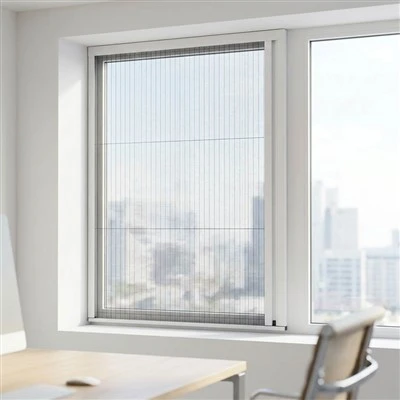
Large screen projects should be managed by breaking total lead time into material preparation, tooling, production, QC, packaging, and shipping stages. For procurement teams, the most reliable method is to confirm each stage before issuing the purchase order rather than relying on a single factory-wide delivery promise.
1. What Screen Production Lead Time Actually Includes
A quoted "15-day lead time" does not necessarily mean the goods will be ready for shipment in 15 calendar days.
For mosquito screen doors and windows, total production time may include:
Purchase order confirmation
Technical drawing approval
Sample approval
Raw-material preparation
Aluminum profile procurement
Mesh preparation
Hardware preparation
Tooling or die production
Cutting and machining
Screen assembly
Functional inspection
Final QC
Export packaging
Container loading
The procurement team should therefore request a production schedule, not only a final delivery date.
Typical lead-time structure
| Production Stage | Typical Time Range* | Main Delay Risk |
|---|---|---|
| Specification confirmation | 1–3 days | Drawing changes |
| Sample approval | 3–10 days | Customer revisions |
| Raw-material preparation | 3–15 days | Stock availability |
| Tooling | 7–20+ days | New profile or component |
| Mass production | 7–30+ days | Order quantity and capacity |
| QC | 1–3 days | Defect correction |
| Packaging | 1–5 days | Custom packaging |
| Container loading | 1 day | Booking schedule |
*Actual timing depends on product type, quantity, customization, raw-material stock and factory production conditions.
2. Calculate Lead Time From the Purchase Order Backward
For large projects, procurement should start with the required arrival date and work backward.
For example:
Required site date → port departure → container loading → final QC → production → material preparation → technical approval → PO
This approach exposes schedule risks earlier.
Example project schedule
| Milestone | Target Date |
|---|---|
| Required arrival at project warehouse | June 30 |
| Estimated sea freight and port handling | 30–45 days |
| Container departure | May 10 |
| Factory loading | May 7 |
| Final QC completed | May 5 |
| Mass production completed | May 1 |
| Production starts | April 10 |
| Materials available | April 5 |
| Final specification approved | March 25 |
| Purchase order issued | March 20 |
The dates above are an example planning structure rather than a universal transit schedule.
The key point is that production lead time is only one component of project lead time.
3. Supplier Capacity Must Match Order Quantity
A factory capable of producing 100 screens per day may have no problem handling a 500-unit order.
A 10,000-unit project is different.
Before placing a large order, ask the supplier to provide:
Current production load
Available production capacity
Number of assembly workers
Number of production lines
Monthly output
Existing project commitments
Material inventory
Planned production window
Estimated daily output
Capacity calculation
If:
Required quantity = 8,000 units
Planned production output = 400 units/day
Working days = 20 days
Then:
8,000 ÷ 400 = 20 production days
If the factory claims a 10-day production period, the buyer should ask how the additional capacity will be provided.
Possible explanations include:
Additional production shifts
Multiple assembly lines
Subcontracted processes
Existing finished-goods inventory
Higher daily output
The procurement team should verify which one applies.
4. Material Availability Often Determines the Real Start Date
Production cannot begin simply because the purchase order has been signed.
The factory may still need to secure:
Aluminum extrusion profiles
Fiberglass mesh
Polyester mesh
PVC-coated mesh
Rollers
Handles
Magnets
Tracks
Springs
Screws
Sealing components
Packaging materials
For standard products, some components may already be in stock.
For customized products, material preparation can become the longest stage.
Material lead-time comparison
| Component | Standard Product | Custom Product | Main Risk |
|---|---|---|---|
| Fiberglass mesh | 1–5 days | 7–20 days | Color/specification |
| Polyester mesh | 1–5 days | 7–20 days | Color/mesh construction |
| Aluminum profile | 3–10 days | 15–30+ days | Extrusion MOQ |
| Hardware | 1–7 days | 7–20 days | Custom design |
| Packaging | 3–7 days | 7–15 days | Artwork/printing |
| Tooling | Usually none | 7–20+ days | New extrusion/profile |
The buyer should ask:
"Are all critical materials physically available, or will they be purchased after we place the order?"
That single question can materially change the actual production schedule.
5. Tooling Can Add Days Before Production Starts
Custom aluminum extrusion profiles, tracks, hardware or plastic components may require tooling.
A project using a standard profile can enter production much faster than a project requiring a new extrusion die.
Tooling schedule
A typical custom aluminum profile workflow may include:
Technical drawing
Die design
Die manufacturing
Trial extrusion
Profile inspection
Sample production
Customer approval
Mass production
Tooling should therefore be treated as a separate project milestone.
Do not include tooling time inside a generic "production lead time" without a written schedule.
6. Technical Approval Must Be Completed Before Mass Production
Specification changes are one of the most common causes of schedule extension.
Typical changes include:
Frame dimensions
Mesh type
Mesh color
Aluminum color
Handle position
Track dimensions
Magnet position
Packaging
Installation method
Labeling
Carton quantity
A project should establish a production freeze date.
After that date, changes should require written confirmation of:
Additional cost
Additional lead time
Affected quantity
Revised delivery date
Recommended approval sequence
Technical drawing → Material specification → Physical sample → Functional approval → Packaging approval → Production release
This prevents production from starting with unresolved specifications.
7. Use Production Milestones Instead of One Final Deadline
Large screen orders should have multiple checkpoints.
Recommended milestone control
| Milestone | Buyer Action |
|---|---|
| PO confirmed | Confirm quantity and specifications |
| Materials ordered | Verify procurement status |
| Materials received | Confirm critical components |
| First article completed | Inspect first production unit |
| 25% production | Check output and defects |
| 50% production | Review schedule |
| 75% production | Confirm shipment plan |
| 100% production | Final QC |
| Packing completed | Verify carton count |
| Container loaded | Confirm shipping documents |
This gives the buyer early warning.
If production is already 20% behind schedule at the 50% milestone, waiting until the promised completion date provides little opportunity to recover.
8. First-Article Inspection Reduces Large-Batch Rework
For large projects, the first production unit should be inspected before full production accelerates.
First-article inspection should include
Overall width and height
Frame squareness
Aluminum profile
Mesh specification
Mesh tension
Hardware position
Operating force
Opening/closing function
Surface finish
Label
Packaging
A first article that fails inspection should be corrected before hundreds or thousands of units are produced.
This is particularly important for custom screen systems.
9. Quality Problems Can Add More Time Than Production
A factory may technically complete an order on schedule but still miss the shipping date because defective units require rework.
Consider:
| Scenario | Quantity | Rework Rate | Additional Units |
|---|---|---|---|
| Planned production | 5,000 | 0% | 0 |
| Minor defect rate | 5,000 | 2% | 100 |
| Higher defect rate | 5,000 | 5% | 250 |
| Major defect rate | 5,000 | 10% | 500 |
If a screen requires partial disassembly to replace mesh, hardware or frame components, rework can consume additional production capacity.
For this reason, screen product QC should be treated as a schedule-control tool, not only a quality function.
10. Packaging Must Be Included in the Production Schedule
Packaging is frequently treated as the last step, but custom packaging can itself require production time.
This applies to:
Printed color boxes
Instruction manuals
Barcode labels
Private-label cartons
Customized polybags
Carton markings
Pallets
Before production begins, confirm:
Packaging artwork approval date
Printing date
Packaging arrival date
Units per carton
Carton dimensions
Gross weight
Shipping marks
A finished screen cannot be loaded if its required packaging is still at the printer.
11. Container Loading Should Be Planned Before Production Ends
For international projects, the factory completion date is not the same as the shipment date.
The logistics chain may include:
Production → QC → Packing → Warehouse → Trucking → Port → Container → Vessel
The buyer should coordinate the estimated cargo-ready date with the freight forwarder.
Container planning data
| Data | Required Before Booking |
|---|---|
| Carton dimensions | Yes |
| Cartons per container | Yes |
| Total CBM | Yes |
| Gross weight | Yes |
| Number of pallets | If applicable |
| Loading method | Yes |
| Cargo-ready date | Yes |
| Shipping marks | Yes |
For large screen projects, packaging dimensions should be confirmed early enough to calculate container utilization.
12. Cost and Lead Time Are Connected
Reducing lead time may increase production cost.
Potential options include:
Overtime production
Additional shifts
Priority material purchasing
Air freight for urgent components
Expedited tooling
Partial shipment
Separate production lines
| Acceleration Method | Cost Impact | Lead-Time Impact |
|---|---|---|
| Priority material purchase | Medium | Medium |
| Overtime | Medium | Medium |
| Additional shift | Medium–high | High |
| Air freight for components | High | High |
| Partial shipment | High logistics cost | High |
| Expedited tooling | Medium–high | Medium–high |
The buyer should compare the cost of acceleration against the financial impact of missing the project deadline.
13. Partial Shipment Can Protect Large Projects
For construction projects, waiting for 100% of the order may not always be the best logistics strategy.
For example:
Total order: 10,000 screens
The supplier could potentially ship:
Shipment 1: 3,000 units
Shipment 2: 3,500 units
Shipment 3: 3,500 units
This may allow installation to begin while the remaining production continues.
However, partial shipments introduce additional:
Freight cost
Documentation
Container handling
Inventory management
Receiving operations
The decision should therefore be based on the project's installation sequence.
14. Choose a Factory-Direct Supplier for Better Schedule Visibility
Working directly with the manufacturing source can simplify communication between procurement, engineering, production and logistics.
A ►[Factory Direct Mosquito Screen Supplier] should be able to provide direct information on:
Material availability
Production capacity
Manufacturing schedule
First-article status
QC progress
Packing status
Cargo-ready date
This is especially useful when the order involves custom dimensions, OEM packaging, multiple SKUs or a large project quantity.
15. Buyer Checklist for Screen Production Lead Time
Before issuing the PO, confirm the following.
Technical
Final technical drawing approved
Mesh specification approved
Aluminum profile approved
Hardware specification approved
Color approved
Installation requirements approved
Sample approved
Production
MOQ confirmed
Production quantity confirmed
Factory capacity confirmed
Material availability confirmed
Tooling schedule confirmed
Production start date confirmed
Production completion date confirmed
Quality
First-article inspection defined
In-process QC defined
Final inspection defined
Acceptance criteria documented
Rework procedure agreed
Logistics
Packaging specification approved
Carton dimensions confirmed
Total CBM estimated
Cargo-ready date confirmed
Container quantity estimated
Shipping schedule coordinated
16. A Practical Lead-Time Management Formula
For project procurement, a useful planning model is:
Total Project Lead Time = Technical Approval + Material Preparation + Tooling + Production + QC + Packaging + Logistics Buffer
For example:
| Stage | Example Duration |
|---|---|
| Technical approval | 5 days |
| Material preparation | 10 days |
| Tooling | 0 days |
| Mass production | 20 days |
| QC | 2 days |
| Packaging | 3 days |
| Factory-to-port handling | 3 days |
| Factory-side total | 43 days |
If international transportation requires another 30–45 days, the procurement team should not plan the project around a 20-day factory production figure alone.
17. How to Compare Two Screen Suppliers
Suppose two suppliers quote the following:
| Item | Supplier A | Supplier B |
|---|---|---|
| Unit price | $18.50 | $19.20 |
| Production lead time | 35 days | 25 days |
| MOQ | 500 | 1,000 |
| QC | Final inspection | First article + in-process + final |
| Packaging | Standard | Project-specific |
| Capacity | 5,000/month | 12,000/month |
| Partial shipment | Yes | Yes |
Supplier A has the lower unit price.
Supplier B has a shorter production schedule and higher stated capacity.
For a time-sensitive 10,000-unit project, Supplier B may have the lower overall project risk even with a higher unit price.
This is why screen production lead time should be evaluated together with capacity, QC and logistics-not as an isolated number.
18. Final Supplier Selection Criteria
Before selecting a supplier for a large screen project, procurement teams should be able to answer five questions:
1. Can the factory produce the required quantity within the required window?
2. Are the required aluminum profiles, mesh and hardware available?
3. Has the technical specification been frozen before production?
4. Are QC milestones linked to the production schedule?
5. Is the cargo-ready date coordinated with the shipping plan?
If the supplier cannot provide clear answers, the project schedule contains an avoidable risk.
Conclusion
Effective lead time management for large screen projects starts before production begins. Buyers should divide the schedule into technical approval, material preparation, tooling, manufacturing, QC, packaging and logistics, with a responsible party and target date for every stage.
For large orders, the most useful supplier is not necessarily the factory promising the shortest number of production days. It is the supplier that can provide realistic capacity data, material status, milestone reporting, controlled QC and a defined cargo-ready date.
B2B Procurement CTA:
Planning a large residential, hotel or commercial screen project? Request a factory production schedule, bulk quotation, technical specification and sample approval plan before placing the purchase order. This gives your procurement team a measurable basis for controlling cost, quality and delivery risk.