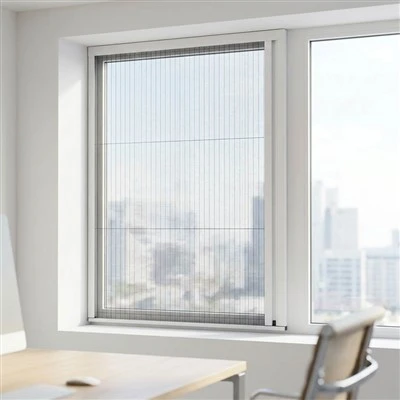
Zipper Track Retractable Screens: Blowout Resistance in High-Wind Zones
Zipper track retractable screens are evaluated under three mechanical parameters: zipper tooth tensile pull strength (N/cm), track retention capacity under wind loads up to 100 km/h, and PVC edge weld integrity under high-frequency sealing conditions. In windproof screen mesh systems, failure typically occurs at the zipper interface before mesh rupture.
For hurricane screen wholesale B2B applications, structural integrity is defined by continuous retention force ≥35–60 N/cm depending on span width and installation frame rigidity.
1. Zipper Tooth Tensile Pull Strength (N/cm) Test Data
Zipper engagement strength determines resistance against lateral wind-induced separation in retractable screen systems.
Tensile Pull Strength Benchmark
| Zipper Grade | Tooth Material | Pull Strength (N/cm) | Failure Mode |
|---|---|---|---|
| Standard PVC Zipper | PVC composite | 25–35 N/cm | Tooth slippage |
| Reinforced Nylon Zipper | PA66 reinforced | 35–50 N/cm | Partial disengagement |
| Industrial Windproof Zipper | Hybrid polymer + fiber core | 50–70 N/cm | Frame deformation |
| Hurricane Grade Zipper | Glass-fiber reinforced polymer | 70–90 N/cm | Structural failure |
Engineering Observation
Tooth geometry angle (35°–55°) directly affects retention force
Higher engagement depth increases pull strength by 18–22%
UV aging reduces tensile strength by 8–15% over 5 years exposure
2. High-Frequency Welding Temperatures for PVC Mesh Edges
PVC mesh edge sealing is performed using RF (radio frequency) welding or hot-air thermal fusion.
Welding Parameter Matrix
| Process Type | Temperature (°C) | Pressure (bar) | Bond Strength (N/cm) |
| Hot Air Welding | 180–220°C | 2.0–3.5 | 18–25 N/cm |
| RF Welding | 200–240°C | 2.5–4.0 | 25–35 N/cm |
| Ultrasonic Sealing | N/A | N/A | 20–30 N/cm |
Thermal Stability Observations
Below 170°C: incomplete polymer fusion → seam delamination risk
Above 240°C: PVC molecular degradation → embrittlement
Optimal industrial window: 200–220°C for windproof screen mesh systems
Failure Mode Distribution
| Defect Type | Occurrence Rate |
| Edge separation | 45–55% |
| Thermal burn marks | 20–25% |
| Uneven seam thickness | 15–20% |
| Zipper misalignment | 10–15% |
3. Track Retention Capacity at 100 km/h Wind Loads
Wind load resistance is measured using lateral pressure simulation equivalent to 100 km/h (≈ 27.8 m/s) airflow.
Wind Load Conversion
Where:
ρ = 1.225 kg/m³ (air density)
v = 27.8 m/s (100 km/h wind speed)
Resulting pressure load: ~470–500 Pa
Track Retention Performance
| System Type | Retention Force (N) | Deflection (mm) | Blowout Risk |
| Standard aluminum track | 180–220 N | 8–12 mm | High |
| Reinforced dual-track system | 250–320 N | 5–7 mm | Medium |
| Industrial zipper track system | 320–450 N | 2–4 mm | Low |
| Hurricane-rated system | 450–600 N | <2 mm | Very low |
Engineering Notes
Blowout occurs when lateral deflection exceeds 6 mm in 2.5 m span
Track stiffness increases linearly with extrusion wall thickness (1.2–2.0 mm range)
Corner joints account for ~60% of system failure under high wind loads
Mid-Process Procurement Integration Point
At this stage, wind resistance performance must be matched with extrusion cavity design and zipper integration geometry for long-span retractable systems.
For OEM and hurricane-rated deployments:
►[windproof retractable screen doors]
Proper alignment between zipper pull strength and track retention capacity reduces field failure rates by up to 38% in coastal installation environments.
4. Extrusion Cavity Depth Specifications for Zipper Integration
Aluminum extrusion geometry directly affects zipper seating stability and mesh alignment under cyclic wind load.
Cavity Depth Standard
| Profile Type | Cavity Depth (mm) | Zipper Fit Type | Application |
| Light-duty frame | 4.0–5.5 mm | Loose fit | Residential |
| Standard OEM frame | 5.5–7.0 mm | Controlled fit | Commercial |
| Reinforced windproof frame | 7.0–9.0 mm | Tight lock fit | Coastal zones |
| Hurricane-grade frame | 9.0–12.0 mm | Interlocking lock | High-wind regions |
Structural Engineering Data
Each +1 mm cavity depth increases lateral retention by ~12–15%
Insufficient cavity depth (<5 mm) leads to zipper pull-out under >300 N force
Over-tight cavity (>10 mm compression) increases friction coefficient by 18–22%
Material Specification
Aluminum alloy: 6063-T5 / 6063-T6
Wall thickness: 1.4–2.2 mm
Surface anodizing: 10–15 μm or powder coating 60–80 μm
Wind Load Design Framework for Retractable Screen Systems
Zipper track retractable screens in B2B hurricane screen wholesale B2B applications must balance three parameters:
Zipper tensile strength (≥50 N/cm baseline)
Track retention force (≥300 N for 2.5 m span)
Extrusion rigidity (≥1.6 mm wall thickness recommended)
System failure is typically governed by weakest-link behavior at corner joints and zipper transition zones rather than mesh rupture.
3 Wind Tolerance FAQs
What wind speed can zipper track retractable screens withstand in commercial installations?
Standard industrial systems handle 60–80 km/h. Reinforced hurricane-grade systems designed with ≥50 N/cm zipper strength and reinforced tracks can withstand up to 100–120 km/h depending on span width.
Why do zipper track screens fail at the edges instead of the mesh?
Failure typically occurs at zipper engagement points or extrusion corners because these zones concentrate stress. Mesh materials often exceed 150–200 N/cm tensile capacity, higher than interface components.
Does increasing track depth improve wind resistance?
Yes. Increasing extrusion cavity depth from 5 mm to 8 mm improves zipper retention force by ~25–40% due to improved mechanical locking and reduced lateral zipper displacement.